
New Archive Acquisition: Tunis Family Bible
By Leslie Potashner
Published in The Review, Spring 2024, Volume 63, Number 1.

Gary Troxell has donated a Tunis family bible to the Harding Township Historical Society. The bible belonged to William Lindsley Tunis, who lived from 1836 to 1897. The small bible is inscribed inside the front cover, “W. L. Tunis, New Vernon, Morris County, New Jersey.” Inside the back cover is written, “William L. Tunis, August 16, 1846.”
William was born in New Vernon in 1836, the son of John Sineus Tunis (1799-1863) and Mahetabel “Hetty” Day Boyle (1802-1873). John was the son of Daniel W. Tunis (1767-1847) and Phebe Lindsley (1772-1833), who established the farm in New Vernon that is now the Tunis-Ellicks House Museum. Hetty was the daughter of Colonel Solomon Boyle and Elizabeth Pierson of Long Hill. Solomon Boyle’s father served in Colonel John Frelinghuysen’s Third Regiment, New Jersey Militia, in the War of 1812, stationed at Paulus Hoeck. The Colonel was the third so named, his name sake emigrated from Ireland, married a French woman living in the colony, and purchased 600 acres from the East Jersey Proprietors in Long Hill.

William was the fourth of six children that John and Hetty had: twins Sineus (1832-1832) and Phoebe Elizabeth “Libby” (1832-1899), Sidney Adolphus (1834-1888), William Lindsey, Susan (1840-1848), and John Sineus (1841-1896).
In 1850, John Tunis and his family—wife Hetty, and their sons Sidney A., William L. And John L., were living in the New Vernon neighborhood of the town of Morris, before the foundation of either Passaic or Harding Townships. The father and 15-year-old son, Sidney, were listed as farmers. Also living with the family were four farm laborers: Thomas Long and Stiles Hand, two White men, and Jacob Truax and Alexander Lovell, both Black men. The fact that the Black men were listed by name, and not on a separate slave schedule, shows they were both freemen before the Civil War. New Jersey had a system of gradual emancipation beginning in 1804, but still had enslaved people when the 13th Amendment was passed in 1866.
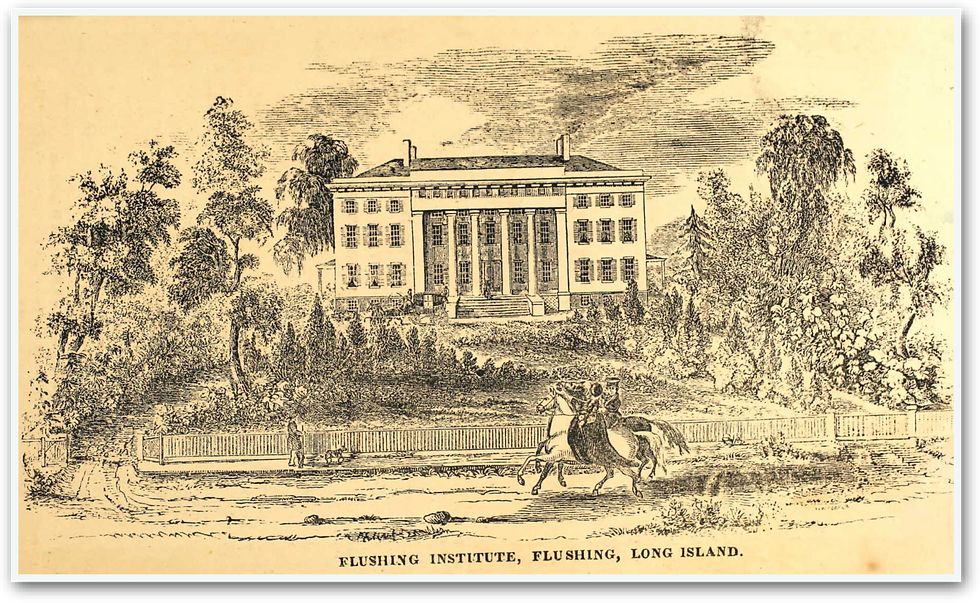
William and his younger brother John were both shown as attending school. William and Sidney attended the Flushing Institute in 1851 and 1852. The Flushing Institute was located in Queens and was formerly known as the Green-Brook Family School of New Jersey in Plainfield. It was run by Ezra Fairchild, Principal, and the staff included his son, Elias Fairchild, as a teacher, also Ezra Thompson, Professor of Music. Ezra Fairchild took over the school in 1845; his son Elias took over after his father’s death in 1854 and ran it until the school closed in 1902. Ezra’s first school was the Hill Top school in Mendham, which was considered one of the finest schools of New Jersey.
William married Mary Anne Cross (1838-1911), on January 4, 1866, in Somerset County. She was the daughter of John Cross, a farmer in Bernards, and his wife, Ann Barkalow. William and Mary had children Anna Martina “Martha” (1867-1912), William Hartley (1869-1869), and Emma Louisa V. “Louise” (1878-1951). In 1870, they lived in Bridgewater. In 1880, he lived in Raritan and worked as a dry goods merchant. In the NJ 1885 census they lived in Raritan but in the 1895 Census, the family was once again living in Bridgewater.
William was the postmaster of New Vernon from 1856 to 1859, and again in 1863. In 1863, William was listed as a merchant in Bernards Township. His brother, John, was the New Vernon postmaster 1874 to 1878 and again 1885 to 1889.
In 1867, he was left three hundred dollars in the will of his friend Elizabeth Prentiss, who owned property on Village Road. She also left the New Vernon Methodist Church $200.
The 1870 and 1880 censuses shows him living in Bridgewater and working as a dry goods merchant. Boyd’s 1872 directory shows him living in Raritan and running a general store. The 1883 directory shows him selling shoes and hats. According to The Courier-News, William ran a real estate business, which was taken over by his wife after his death.
William died June 5, 1896, aged 60, of heart disease in Bridgewater, and was buried in the New Vernon Presbyterian graveyard along with his father, John (1799-1863), his mother, Hetty nee Boyle (1802-1873), and his sister, Libbie (1832-1893). His wife, Mary Ann nee Cross (1837-1911) is buried in Somerville along with his older daughter, Anna Martina Gray who married William N. Gray (1867-1932), an undertaker, in 1901 in Cranford. The younger daughter, Louise Victoria married Guy Hallowell, a watchmaker, and moved to California.


Comments